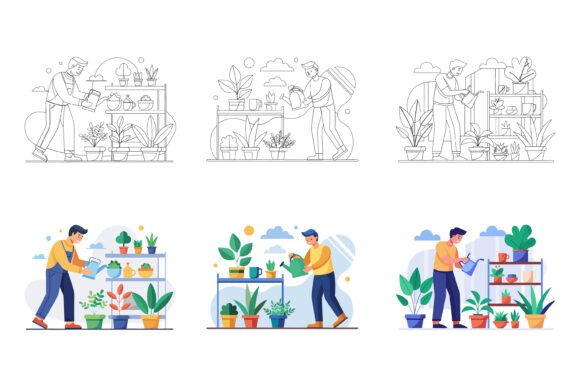
Greenery & Ecology Flat Vector: Real Design Value
Modern visual communication often hinges on the ability to convey complex ideas with simplicity and warmth. The Greenery, Ecology -modern Flat Vector collection fills a specific gap for anyone who needs to talk about sustainability, nature, or growth without relying on tired stock photography. Instead of generic images, you receive a set of clean, adaptable illustrations built around botanical themes, environmental concepts, and organic shapes. The appeal lies not only in the aesthetic but also in how effortlessly you can integrate these assets into a variety of creative projects.
What you are looking at goes beyond a simple clip‑art pack. Hello and welcome to a special AI EPS illustration collection that prioritizes workflow efficiency. The files arrive neatly organized with a clear layer structure, which means you spend less time hunting for objects and more time designing. Whether you are preparing an app interface, an infographic about climate data, or printed educational materials, the consistency in detail and style helps your pieces feel cohesive. The deliberate choice to use a modern flat vector approach removes unnecessary noise, letting the core message shine through.
Why This Visual Style Speaks to Today’s Audiences
Flat vector illustrations have become a trusted design language because they reduce cognitive load. In a world saturated with high‑contrast photos and 3D renders, the gentle geometry and restrained color palettes of greenery‑themed artwork provide a calming visual pause. The Greenery, Ecology -modern Flat Vector style uses simplified leaves, planters, recycling symbols, sunbursts, and human figures interacting with the environment. This helps your audience grasp the message in an instant. There is no cluttered background competing for attention; every element serves a purpose.
Moreover, flat vectors scale perfectly. Put them on a large banner for a community garden event or shrink them down for a mobile eco‑tracking app icon – the crisp edges remain intact. The absence of photographic textures means your materials will print cleanly on recycled paper stocks and still look professional. This visual clarity directly supports trust: when a nonprofit uses these illustrations to report on reforestation efforts, the straightforward graphics feel honest and accessible, not marketing‑fluff.
Who Gains the Most from This Illustration Set
The user base for nature‑centric vector art is surprisingly wide. Small business owners running organic cafés or plant shops can quickly brand their loyalty cards and social posts without hiring a dedicated designer. Educators building presentation slides about photosynthesis or recycling find that the consistent illustration style reduces visual distraction for students. Freelance graphic designers, on the other hand, value the time saved when a client asks for an infographic about carbon footprint – having a ready‑to‑edit collection of recognizable eco‑symbols shortens the briefing process considerably.
Bloggers and content marketers also benefit. An article about sustainable living becomes more scannable when broken up with custom‑colored icons that match the site’s palette. Even UI/UX professionals can use the individual symbols as part of an onboarding flow for a green‑tech app. The collection’s flexibility means you are not locked into a single “look and feel”; you can extract just a seedling icon or a hand holding a globe and apply your brand’s styling. This modularity makes the Greenery, Ecology -modern Flat Vector set a resource you come back to repeatedly, not a one‑time download.
Structured for Speed: What the AI EPS Format Brings
One of the most overlooked aspects of choosing illustration assets is file architecture. The package includes AI EPS files designed for both Mac and Windows users, which immediately removes compatibility friction. More importantly, the layers and objects are labeled logically. Instead of seeing “Layer 1” and “Group 23,” you might find a parent layer named “Trees” with children like “Oak,” “Pine,” and “Sapling.” This thoughtful organization drastically reduces the time it takes to isolate, duplicate, or hide components in Adobe Illustrator or similar vector software.
Because the files maintain a neat structure, batch adjustments are straightforward. Need to change all leaf motifs from a bright green to an autumnal rust? You can select elements globally, apply a new swatch, and watch the entire composition adapt. This level of control matters when you are iterating through client feedback or A/B testing a landing page’s visual theme. The included JPG previews also serve as a quick reference, so you can browse and choose which file to open without loading every vector into memory.
Editing Without the Headache: Make It Your Own
A common frustration with pre‑made graphics is the feeling of being boxed in – the colors clash with your brand, or a particular leaf shape needs a slightly rounder finish. Here, the promise of easy modification holds true because the vector nature allows for node‑level editing. You can recolor the recycling bins, adjust the thickness of a vine, or combine two separate illustrations to form a new scene. Since the artwork was created with consistency in mind, any changes you make won’t stick out awkwardly. The same line weight and geometric logic run across the whole collection.
This editable quality pays dividends when you are crafting a branded ecosystem. Imagine a city council using these icons for a public awareness campaign about composting. They might need the bin icon in municipal green, the food scraps in a warm earth tone, and the instructional text in the official typeface. The Greenery, Ecology -modern Flat Vector files accept such alterations gracefully, and because the source layers are preserved, a junior designer or a volunteer can handle the task with minimal training. You maintain visual integrity even as you shift colors and compositions.
Practical Use Cases Across Print, Web, and Beyond
The suitability for print, web, symbols, apps, and infographics is not just a list of buzzwords; it reflects real‑world application flexibility. For print projects, you can export the vectors at 300 DPI to create crisp handouts, event banners, or educational posters without any pixelation. Web deployments benefit from the SVG output potential – the flat colors compress well and load quickly, improving Core Web Vitals. App designers can strip down an illustration to its core outline and use it as an intuitive icon, while infographic creators can stitch multiple elements together to tell a data‑rich story about energy consumption or biodiversity.
Consider a marketing team launching a webinar on green business practices. They need a slide deck header, a social media promo, and an email signature graphic – all within two days. With the collection, they grab the cityscape‑with‑trees illustration for the keynote, isolate the solar panel icon for the email footer, and place the reusable bag vector over a soft gradient for Instagram. The visual thread ties the campaign together without the expense of custom illustration work. Even a hobbyist managing a community garden’s newsletter can produce a polished masthead by modifying the gardening‑themed assets. The cross‑media readiness is a genuine time‑saver.
Consistency and Detail: The Underrated Trust Builders
Perfection in details often separates a professional output from an amateur one. If you examine the stem joints, the curvature of a water droplet, or the proportion of a hand holding a plant, you notice that each element has been balanced to avoid awkward tangents. This level of precision means you can blow an illustration up to billboard size and still have smooth curves. For brands that care about credibility, such attention to detail signals that you value quality even in the smallest visual component of your communication.
Consistency across many icons is equally critical. When you use ten different ecology symbols from ten scattered sources, small mismatches in stroke width or corner radius can subconsciously unsettle the viewer. Here, a single artistic hand has governed the entire set. The result is a unified library where the “electric car” icon feels like it belongs next to the “wind turbine” icon. This harmony saves you from spending hours hunting for assets that match. It also supports stronger brand recall because your audience sees a cohesive visual language rather than a patchwork.
Who Should Think Twice and What to Watch For
Nothing is universally perfect, and honest evaluation includes acknowledging when this collection might not be the best fit. If your project demands highly realistic 3D rendering of specific endangered species or photographic accuracy for a scientific field guide, flat vectors will likely fall short. Similarly, teams already flooded with proprietary illustration libraries may only need a few specific motifs – purchasing the entire set could feel excessive unless you plan to reuse the assets across multiple campaigns.
Editing does require access to vector editing software like Adobe Illustrator, CorelDRAW, or the free Inkscape. While the JPG files provide quick‑and‑dirty inserts, unlocking the full customization potential means sitting down with a compatible program. If you are a solo entrepreneur who never touches design tools and always outsources tasks, make sure your designer can work with AI EPS formats. Additionally, because the style follows the modern flat trend, it will naturally evolve over time. The current aesthetic is highly versatile, but in five years you may wish to refresh your toolkit—though the foundational symbols like leaves and globes rarely age badly.
Welcoming This Toolkit into Your Creative Process
Hello and welcome to a special AI EPS collection that arrives ready to reduce friction in your daily design tasks. What makes these illustrations special for you is the combination of an approachable green theme with meticulous file hygiene. The neatly organized layer structure, cross‑platform compatibility, and the balance of detail and simplicity mean you can go from downloading to prototyping in under an hour. There is a quiet confidence that comes from knowing your visual assets will never pixelate, never clash, and never force you to compromise your message because of a poorly constructed source file.
When you start using these illustrations, you may find yourself reaching for them in unexpected ways. A teacher creates a classroom reward chart using the eco‑badge icons. A financial advisor builds a report cover about ESG investing with the sustainable growth graphics. A local café owner designs a take‑away menu that spotlights locally sourced ingredients with the farm‑fresh vectors. The creative possibilities expand because the resource is not prescriptive; it invites you to adapt, combine, and repurpose. That freedom is what transforms a simple illustration pack into a long‑term companion for visual storytelling around nature, responsibility, and forward‑thinking design.