Working With Bamboo Silhouettes in Vector Illustration Projects
There is a quiet confidence in well-executed botanical linework. When a designer needs organic forms that read clearly across scales, bamboo silhouettes often enter the conversation. Not because they are loud or trendy, but because they carry a structural elegance that translates across print, screen, and symbol-based design without losing clarity. The challenge, however, is finding a set that balances detail with editability, and visual appeal with practical file management. This is where a carefully assembled AI EPS collection can shift a project from acceptable to genuinely polished.
Some illustration packs arrive with impressive previews but unravel the moment you dig into the layers. Others are rigid, locking you into color choices or compositions that fight against your layout. A thoughtfully built bamboo silhouettes collection sidesteps these frustrations by prioritizing how actual designers work—across different operating systems, software versions, and output requirements. The difference becomes apparent within the first few minutes of opening a file.
What Defines a Useful Bamboo Silhouettes Collection
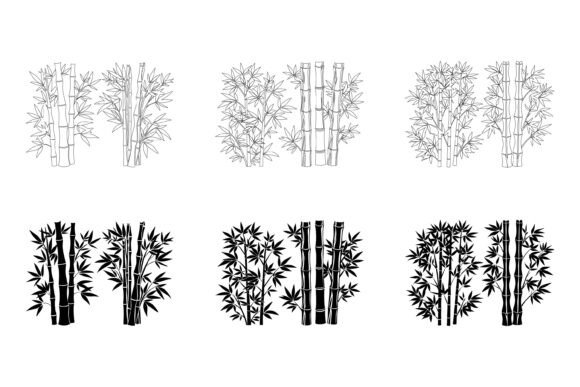
Not all vector sets are created equal. The defining characteristic of a professional-grade bamboo silhouettes resource is not the quantity of assets but the quality of their construction. Each silhouette should feel intentional rather than auto-traced, with smooth bezier curves that hold up at billboard dimensions and remain legible when scaled down to icon size. The natural tapering of bamboo leaves, the subtle spacing between nodes on a stalk, the way light filters through a cluster of culms—these details separate generic outlines from silhouettes that feel botanically convincing.
Beyond aesthetics, file organization matters in ways that become painfully obvious during deadline-driven work. A collection that arrives with clearly named layers, grouped elements, and consistent artboard structures saves hours of hunting and rebuilding. When every bamboo silhouette sits on its own logically labeled layer, integrating specific elements into a larger composition becomes a matter of dragging and dropping rather than detangling a mystery file.
Format Flexibility and Cross-Platform Reliability
The inclusion of AI, EPS, and JPG formats in a single package is more than a convenience—it is a practical acknowledgment of diverse workflows. AI files preserve full editability within Adobe Illustrator, letting you adjust stroke weights, modify anchor points, and recolor individual elements without degradation. EPS files extend compatibility to CorelDRAW, Affinity Designer, and older software versions that some print shops still rely on. JPG previews or flattened versions provide quick reference and can serve as placement assets when full vector editing is unnecessary.
Equally important is the guarantee that files function on both Mac and Windows systems. Cross-platform compatibility is not automatic; font embedding, path rendering, and even color profiles can behave differently across operating systems. A collection designed and tested for both environments signals an attention to real-world usage that many illustration packs overlook. This reliability reduces the friction of collaboration between team members on different machines or the handoff from designer to client.
Practical Applications Across Media Types
The versatility of bamboo silhouettes extends well beyond the obvious nature-themed projects. Here are several contexts where these assets find genuine utility:
- Brand identity systems — Bamboo motifs carry connotations of resilience, growth, and sustainability. A silhouette can function as a primary mark, a subtle background texture, or a supporting icon within a larger visual language.
- Infographics and data visualization — When statistics relate to environmental topics, agriculture, or Asian market trends, bamboo silhouettes provide culturally resonant visual anchors that are instantly recognizable.
- App interface elements — Meditative, wellness, and productivity applications often incorporate natural imagery. Clean silhouettes work as onboarding illustrations, category icons, or empty state graphics without overpowering the UI.
- Print collateral — From event posters to product packaging, vector bamboo artwork reproduces cleanly at any size, on any substrate, without the pixelation risks that raster images carry.
- Web and social media graphics — Silhouettes layer beautifully over photography, gradient backgrounds, or solid color blocks, offering a fast way to add depth and thematic cohesion to digital compositions.
The consistent quality across all assets in a collection means you can pull multiple silhouettes into a single project without jarring style mismatches. That cohesion is difficult to achieve when sourcing individual illustrations from disparate free libraries.
Editing Freedom and Color Customization
One of the most valuable features of a well-structured vector illustration set is unrestricted editability. A designer rarely uses a stock asset exactly as supplied. Color adjustments are the most common modification—transforming a solid black silhouette into a soft sage green for a spa brand, a metallic gold for luxury packaging, or a muted charcoal for editorial layouts. When bamboo silhouettes are built with clean, unflattened vector paths, these color changes take seconds rather than requiring tedious isolation work.
Beyond color, the ability to modify individual elements opens creative doors. You might remove a few leaves to fit a specific aspect ratio, combine stalks from different files to build a custom grove, or extract a single culm for use as a divider line. Layered file structures make this kind of surgical editing feasible, while flat or poorly organized files turn it into a reconstructive effort that often takes longer than drawing from scratch.
Detail Consistency and Production Values
An underappreciated quality in illustration sets is internal consistency. When you examine a collection of bamboo silhouettes side by side, the line weight, level of detail, curvature style, and density should feel uniform. Inconsistent sets force designers into corrective work—thickening one silhouette's stems to match another, simplifying over-detailed elements, or adding missing features to sparse renderings. A collection that maintains perfection in details across every asset demonstrates a production process that values cohesion over speed.
This consistency matters especially when multiple silhouettes appear together in a single composition, such as a border treatment, a repeating pattern, or an illustrated scene. The eye detects even subtle variations in style, and those discrepancies can undermine the professional impression a project is meant to convey.
Who Gains the Most From These Resources
Graphic designers working on branding projects will appreciate the balance of recognizability and abstraction that good bamboo silhouettes provide. The forms are distinctive enough to read instantly yet stylized enough to integrate with diverse visual identities.
Small business owners managing their own marketing materials benefit from the ease of use. With JPG previews for quick placement and fully editable vector files for final production, the learning curve flattens considerably. You do not need advanced Illustrator skills to change a color, scale an asset, or combine two silhouettes into a logo concept.
Educators and content creators producing presentations, worksheets, or digital courses can use these illustrations to add visual interest without the distraction of overly complex artwork. Bamboo silhouettes strike a balance between decorative and functional, supporting content without competing for attention.
Web developers and app designers building interface components will find the clean paths export cleanly to SVG, maintain small file sizes, and render sharply on high-DPI displays. The organized layer naming also translates into sensible SVG group structures when exporting from vector applications.
Realistic Observations and Limitations to Consider
No illustration set fits every possible use case. Bamboo silhouettes, by their nature as outline or solid-shape representations, lack the texture and depth of fully rendered botanical illustrations. If a project demands photorealistic bamboo with gradient shading, bark texture, and environmental lighting, silhouettes will not satisfy that brief. They excel in graphic, symbolic, and stylized contexts—not hyper-realistic ones.
Additionally, while well-constructed vector files are infinitely scalable, the visual weight of a silhouette changes at extreme sizes. A bamboo stalk that looks balanced at poster scale may feel too heavy or too light at icon dimensions. Designers should test assets at their intended output size and adjust stroke weights or simplify forms as needed. The editable nature of the files makes this feasible, but it remains a step worth anticipating.
Another consideration is cultural context. Bamboo carries specific meanings in various traditions—resilience in Chinese culture, prosperity in some Southeast Asian contexts, simplicity in Japanese aesthetics. Using these silhouettes thoughtfully, with awareness of the audiences and messages involved, adds a layer of professionalism that goes beyond technical execution.
Integrating Bamboo Silhouettes Into Long-Term Workflows
A worthwhile illustration collection earns its place in a designer's permanent library, not a single project folder. Bamboo silhouettes have enough versatility to reappear across branding, editorial, environmental, and digital work over months and years. The key is organizing the assets upon import so they are quickly retrievable when needed. Renaming files with descriptive tags, creating a dedicated folder within your asset management system, and saving customized versions with color palettes specific to recurring clients or projects all extend the practical value of the initial purchase.
For professionals who regularly produce materials related to wellness, sustainability, Eastern cuisine, meditation, gardening, or corporate responsibility, bamboo silhouettes become a go-to visual shorthand. The time saved by having reliable, editable, high-quality vectors at hand compounds with each use, far exceeding the upfront investment.
Evaluating Quality Before Commitment
When assessing any illustration set, including bamboo silhouettes collections, there are a few quick checks worth performing before integrating assets into client work. Open the AI or EPS file and inspect the paths in outline mode—clean, minimal anchor points indicate professional construction, while excessive nodes suggest auto-tracing that will complicate editing. Zoom into leaf tips and stalk joints, where poorly built vectors often reveal themselves with awkward intersections or unnatural sharpness. Test a color change on a complex silhouette to gauge how cleanly the fills update. Finally, export a sample to SVG or PDF to verify that the file structure remains intact through format conversion.
These five minutes of examination can prevent hours of frustration later, and they separate collections built by illustrators who understand production requirements from those assembled primarily for preview screenshots.
Bamboo silhouettes occupy a distinctive niche in the visual asset landscape. They are simultaneously specific and adaptable, culturally resonant and stylistically neutral, simple in concept and demanding in execution. A collection that delivers on format compatibility, layer organization, editability, and detail consistency offers more than convenience—it provides a dependable creative tool that respects the realities of professional design work. When preview images align with what you actually receive when you open the files, that is a resource worth keeping close.