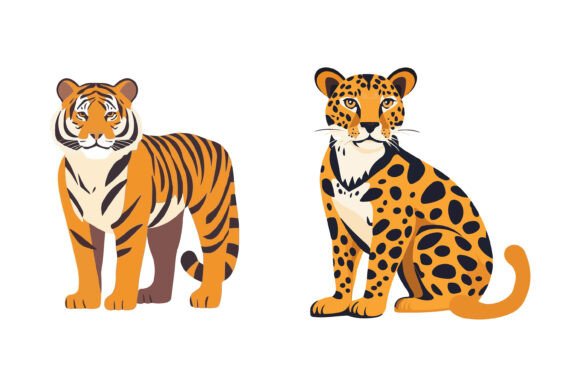
Tiger: A Complete AI EPS Illustration Set for Creative Professionals
When designers, business owners, or content creators search for high-quality visual assets, they often look for a blend of versatility, professional finish, and effortless editability. The Tiger illustration collection answers that need with a thoughtfully curated bundle of vector graphics that work across print, web, mobile apps, and dynamic infographics. This article takes an experience-driven journey through what makes the Tiger AI and EPS set genuinely useful, from its cross-platform readiness to its layered, customizable structure. By the end, you'll know exactly how to evaluate whether this kind of asset fits your next project—and how to start using it with confidence.
Hello Welcome to Our Special AI EPS Collections
You may have stumbled upon the phrase Hello Welcome to Our Special AI EPS Collections while browsing for illustration packs. It’s more than a greeting—it marks the gateway to a carefully engineered library where each set, including the Tiger bundle, has been assembled with real-world usage in mind. Every illustration, symbol, and icon in this collection has been tested for clarity, scalability, and layer transparency. For someone who has spent years wrangling messy stock vectors, the difference is immediate: everything sits where you expect it, named in a way that makes sense, and ready to drop into any project.
Why AI and EPS Formats Matter
The Tiger collection arrives in two industry-standard vector formats: Adobe Illustrator (AI) and Encapsulated PostScript (EPS). For anyone unfamiliar with the deeper implications, AI is the native format for Adobe’s powerhouse design tool, retaining full editability of paths, shapes, gradients, and text. EPS acts as a universal print-ready container that virtually all professional layout programs can open—think CorelDRAW, Affinity Designer, Inkscape, and even older publishing platforms. Together, they guarantee that the Tiger set doesn’t lock you into a single software ecosystem.
The included high-resolution JPG previews offer an additional convenience layer. You can scan thumbnails quickly, drop a raster version into a presentation, or use them as reference without opening heavy vector files. This trio of formats—AI, EPS, JPG—means the Tiger bundle covers brainstorming, production, and final delivery in one download.
Designed for Mac and Windows Users Without Friction
One of the most overlooked pain points with design resources is operating system compatibility. The Tiger illustration set was built to work seamlessly on both Mac and Windows. File naming avoids special characters, folder structures follow a logical pattern, and fonts—if any—are outlined or embedded so you won’t face missing typeface errors. The result is a smooth unpacking experience: download, extract, and start working, whether you’re on macOS Sonoma or Windows 11. This cross-platform thoughtfulness makes the Tiger set a reliable asset for collaborative teams where designers switch between environments daily.
Neatly Organized Files and Logical Layer Structure
If you’ve ever opened a stock vector only to find hundreds of unnamed layers grouped chaotically, you’ll appreciate the discipline behind the Tiger collection. Every file follows a consistent naming convention and folder hierarchy. Inside the main directory, subfolders sort illustrations by theme, object type, or complexity. Within each AI or EPS file, layers are clearly labeled—background, foreground, accent elements, and editable symbols—so you can isolate exactly the part you need without hunting. This organization does two things: it saves an enormous amount of time during tight deadlines, and it makes the Tiger set extremely beginner-friendly for those learning vector editing.
Perfection in Details and Consistency Across the Board
Premium illustration work is defined by continuity of style, stroke weight, corner rounding, and color palette. The Tiger collection nails this. Characters, objects, and icons within the pack share the same visual language. Line widths don’t randomly fluctuate; curves are uniformly smooth; proportions feel intentional. This consistency means you can mix and match elements from different files without an obvious “cut‑and‑paste” look. For infographic designers, UI/UX creators, and presentation builders, that uniformity is invaluable—it lets you assemble a coherent visual story using multiple Tiger assets while maintaining brand polish.
Versatile Use Cases: Print, Web, Apps, and Infographics
The Tiger illustration set isn’t confined to a single medium. Here’s where its versatility shines in practical scenarios:
- Print media – Scale any illustration freely for posters, brochures, business cards, or trade show banners. EPS files integrate directly with professional print workflows, and the crisp vector edges ensure no pixelation at even billboard sizes.
- Web and UI design – The AI layers can be exported as SVG or high-resolution PNGs for websites, landing pages, and dashboards. Alter colors to match a digital brand palette without losing the original quality.
- Mobile applications – Use the simplified icon variants as navigation symbols, onboarding screens, or feature badges. Their clear silhouettes and consistent padding fit mobile grid systems perfectly.
- Infographics and data visualization – Illustrations from the Tiger collection can replace generic clipart, making statistical presentations more engaging while preserving a professional look. Combine elements to build custom pictograms.
- Symbol and signage systems – Many pieces are abstracted enough to serve as universal symbols in wayfinding, manuals, or product labels.
This multi-purpose design means one Tiger download can feed months of diverse projects, reducing the need to hunt for new assets each time a brief changes medium.
- Open the AI or EPS file in your preferred vector editor.
- Identify the component you need through the well-labeled layers panel.
- Export in the target format (EPS for print, SVG for web, PNG for presentations) at the required resolution.
Edit It, Change Colors, and Modify Icons with Ease
The true power of the Tiger collection lies in its editability. Because every element is a pure vector shape, you can click on any part—a character’s hair, a geometric accent, a background circle—and recolor it instantly using the swatch panel. Global color edits are possible if the designer used linked swatches; even if not, direct selection makes hue shifts simple. Need a thicker outline? Adjust stroke widths. Want to combine two icons into a new symbol? Drag and drop layers while holding alt to duplicate, then merge paths. This flexibility lets you adapt the Tiger illustrations to strict brand guidelines or experimental art directions without starting from scratch.
Even without advanced Illustrator skills, basic modifications are approachable. Most modern vector apps have a “recolor artwork” feature; load a Tiger file, choose your palette, and the entire set can reflect a new color mood in minutes. The maintainability goes further: if a project scope changes late, you don’t need to renegotiate licenses or re-source graphics—you simply tweak the existing Tiger assets.
Who Gains the Most from the Tiger Collection?
While nearly anyone who needs polished visuals can benefit, a few groups stand out:
- Small business owners and entrepreneurs – Build professional-looking social media posts, product sheets, and pitch decks without hiring a full-time designer. The Tiger pack acts as a mini design department.
- Marketing professionals – Quickly generate consistent ad creatives, email headers, and blog graphics. The organized layers let you repurpose the same illustration in different campaigns by swapping a few colors.
- UI/UX designers and app developers – The uniform icons and spot illustrations fit neatly into design systems, especially when you need custom but cohesive pictograms for features or settings.
- Educators and content instructors – Create visually rich handouts, slide decks, and online course materials that capture attention without clashing styles.
- Print-on-demand and merchandise sellers – Because the files are fully scalable, you can place Tiger illustrations on T‑shirts, mugs, and tote bags with confidence that the output will remain sharp.
Practical Considerations and What to Expect
No design resource is a magic wand, and the Tiger collection is no exception. To use AI files effectively, you’ll need software that can handle native Illustrator files—Adobe Illustrator itself is ideal, but Affinity Designer and some newer versions of CorelDRAW can open them. The EPS format is more universally forgiving, so if you’re on a tight budget, free tools like Inkscape can import EPS layers, though some complex gradients may require tweaking. Also, the high level of detail means that very old computers might lag when opening a large composite file; closing unneeded layers or working on individual components solves this easily.
Additionally, while the layer structuring is neat, users completely new to vector graphics will still face a small learning curve. However, the consistent labeling of layers dramatically shortens that learning process compared to chaotic stock files. For the vast majority of intermediate and advanced users, the Tiger set drops right into their workflow.
Real-World Scenarios: Putting Tiger to Work
Imagine a freelance graphic designer tasked with creating a 20-page sustainability report for a corporate client. The Tiger bundle provides nature-themed icons, clean infographic symbols, and people illustrations that share a single visual tonality. The designer can take a cityscape from one file, a recycling symbol from another, and a group of stylized people from a third, all blending seamlessly. Color accenting is shifted to match the client’s mint-green brand color, and the entire graphics suite is ready within a few hours—no external assets needed.
A different scenario: a startup founder is building a pitch deck to present to investors. Using the Tiger collection, they pull in conceptual illustrations that explain a complex process. Since the slides will be projected on a large screen, vector scalability guarantees no blurriness. If a last-minute request demands a different background color for contrast, the founder can open the AI file, select the background layer, and fill it with a new shade in seconds.
How to Evaluate if Tiger Fits Your Needs
Before adding any illustration pack to your toolkit, ask a few practical questions:
- Style alignment: Review the preview JPGs and check whether the overall aesthetic meshes with your brand or project’s visual voice. The Tiger collection leans into a modern, polished graphic style, but your specific niche might need something more hand-drawn or photographic.
- Software access: Do you own a vector editing program capable of opening AI or EPS files? Even if not, the JPG files provide usable raster versions for simple tasks.
- Volume versus need: A large pack like Tiger is a great value if you’ll use many illustrations across different projects. If you only need one single icon, a free resource might suffice, but the long-term reusability of this set often justifies the investment.
- Customization comfort: Assess your own editing skills. Because the Tiger files are so well-organized, even beginners can perform simple recolor and resizing. The ability to deep-edit paths grows with you as your skills improve.
Long-Term Value and Extended Creative Freedom
One underrated advantage of owning a carefully engineered asset like the Tiger set is creative momentum. When a spontaneous idea hits—maybe a quick social media graphic or a mockup for a client—you don’t interrupt the flow by searching online for the “right” icon. You already have a library of consistent, high-quality building blocks at your fingertips. Over time, as you learn more about vector editing, you can deconstruct the Tiger layers to see how professional objects are constructed, effectively learning by reverse-engineering.
The Tiger collection is not merely a one-time download; it becomes a adaptable design partner. Files sit on your hard drive, ready to be remixed into future projects that may look completely different. This recyclability is key for agencies and freelancers who juggle multiple clients with varying visual needs—a single pack can service everything from a tech startup’s playful app illustrations to a non-profit’s serious annual report.
Getting the Most Out of Your Tiger Illustrations
To unlock the full potential of the Tiger AI and EPS set, adopt a few workflow habits:
- Set up a dedicated “Tiger Assets” folder with separate subfolders for original files, edited variations, and exported PNG/SVGs.
- When you modify an illustration for a specific project, save it as a new AI file with a descriptive name; keep the original intact for future reuse.
- Use global color swatches in Illustrator so you can change the entire color theme in one edit, then export a batch of icons in the new scheme.
- Combine elements from different Tiger files into a single composition by copying layers. Because the style is consistent, composite scenes still look coherent.
These small habits multiply the utility of your Tiger collection, turning it into an evolving resource rather than a static folder.
In a digital landscape overloaded with generic, mismatched graphics, the Tiger AI and EPS illustration set stands out for its polished craftsmanship, thoughtful organization, and genuine cross-platform ease. Whether you’re printing a large banner, designing a mobile app interface, or enhancing an infographic, this collection provides the professional finish and editability that modern creators demand. By understanding your own workflow, style preferences, and required output formats, you can judge the Tiger pack on its merits—and chances are, it will become the backbone of many successful visual projects.