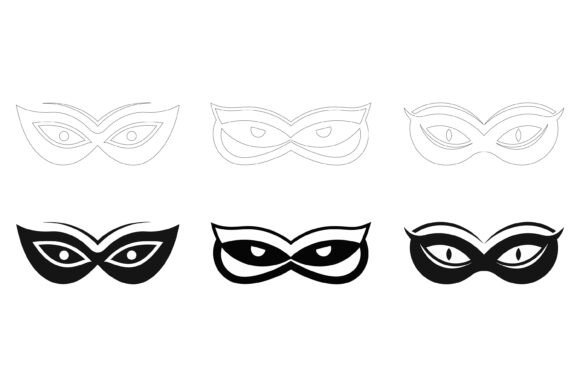
The Mask AI EPS Illustration Collection: A Practical Look at Vector Assets That Work
When a visual project needs an instantly recognizable symbol that can adapt from serious to playful, mask imagery carries a unique weight. The Mask illustration set from these special AI EPS collections arrives as a curated package of themed vector graphics built to drop directly into professional workflows. But beyond the surface appeal, what actually makes the collection worth a designer’s time? This examination walks through the file architecture, editability, real-world performance, and the kinds of professionals who stand to gain the most from integrating these assets.
What You’re Actually Getting in the Mask Collection
The package delivers source files in Adobe Illustrator (AI) and EPS formats, accompanied by high‑resolution JPG previews. The vector originals are cross‑platform ready—designers on macOS or Windows can open and manipulate them without conversion friction. The asset range spans a variety of mask motifs, from medical face coverings and theatrical masks to stylized masquerade designs, giving you a visual vocabulary that shifts tone depending on the context. Each illustration arrives with a neat, clearly named layer structure, so isolating a specific mask element—or an entire group—requires only a few clicks in the Layers panel.
Consistency in Detailing: The Mark of a Professional Set
What separates a carefully assembled illustration pack from a throwaway download often comes down to consistency. Across every mask graphic, you’ll notice uniform line weights, matching stroke terminals, and a coherent visual language. Place a series of these icons into an infographic or an app onboarding sequence, and you won’t encounter jarring stylistic jumps. That level of control becomes even more critical when icons are scaled, recolored, or arranged next to each other in a multi‑page document. The assets hold their personality without any piece demanding undue attention.
Layer Organization That Saves Real Time
Many vector bundles arrive with all elements dumped onto a single layer or, worse, with generically labelled layers that demand detective work. Here, the layer hierarchy is logical and transparent—primary shapes, highlights, background accents, and grouping containers are clearly separated and named. You can toggle visibility, extract a standalone icon, or repurpose a background ring without unearthing hidden clipping paths. For team environments where multiple hands touch a file, this clarity reduces the miniature briefings that eat into a morning schedule.
Color and Shape Customization Without Friction
The paths inside these AI and EPS documents are constructed with clean, un‑flattened strokes and fills. You can alter the entire palette of a mask icon using Illustrator’s Recolor Artwork tool in seconds, or manually tweak anchor points to create a custom silhouette. Because the strokes are expandable and the fill areas respond predictably, global edits don’t unravel the design. Want to transform a theatrical mask into a tech‑brand visual? Swap the gold tones for a cool gradient, slightly round a jawline, and you’ve got a fresh asset without rebuilding from scratch.
Print and Large‑Format Usage
Vector scalability means the same mask graphic that fits a business card can stretch to a tradeshow banner without degradation. The EPS files are especially welcome when a commercial printer requests a certain version—they open reliably in older software and maintain their precision. For packaging, editorial layouts, or corporate stationery, the crisp lines hold up under the scrutiny of high‑DPI output.
Digital Platforms and UI Integration
On the screen side, the assets export smoothly to SVG for web or app interfaces. Icon‑ready compositions fit naturally as tab bar elements, notification symbols, or feature highlights. In infographics, the thematic cohesion of mask illustrations helps unify data storytelling around health, privacy, entertainment, or security topics. Because the JPG files are likely provided at a production‑ready resolution (often 300 DPI), they also serve as quick‑insert visuals in presentations, wireframes, or social media templates when full vector editing isn’t necessary.
Who Stands to Benefit the Most from These Assets
- Marketing designers who build campaigns around symbolic imagery will find the pre‑built mask icons a useful foundation, ready to adapt to a brand’s color scheme in minutes.
- UI/UX designers can integrate editable vectors into prototypes and production apps without worrying about pixel alignment or style drift.
- Educators and content creators assembling slide decks, worksheets, or online courses can leverage the clear metaphorical punch of mask graphics while the organized files make iteration painless.
- Small business owners managing their own packaging, labels, or social graphics can grab the JPG versions for rapid posting and keep the AI files on hand when a professional print run looms.
- Freelancers and agencies who juggle multiple client brands will value the ability to recolor and slightly alter the same base forms, avoiding visual fatigue across a diverse project load.
Under the Hood: File Structure and Cross‑Platform Reliability
Testing the files on both a modern Mac running the latest Illustrator and a Windows machine with an older Creative Suite version, the AI and EPS documents open without error. The layer naming follows a descriptive pattern, not a meaningless “Layer 1, Layer 2” default. This means that when you revisit a file six months later, you immediately understand the composition. For collaborative workflows, handing off a file doesn’t come with a side of oral instructions—the structure speaks for itself. The JPG previews also double as quick visual references, so you can scan a folder and spot the graphic you need before ever launching Illustrator.
Practical Use Cases: From Concept to Final Deliverable
Consider a health‑tech startup developing an app that uses a mask icon to convey privacy or anonymity. The design team pulls the AI file, shifts the base color to the brand’s teal, and exports an SVG for the developer. For the onboarding carousel, they tug the same icon, add a soft gradient, and place it inside a circular background—all editable within the original layer setup. Marketing later needs a version for a printed flyer; they open the EPS, scale it to 300% without a hint of blur, and slightly increase the stroke weight for better readability on matte paper. The fluid movement from screen to print, all stemming from a single well‑organized source file, illustrates the practical advantage over less‑adaptable alternatives.
Where the Mask Set Might Fall Short
No curated pack fits every scenario perfectly. Because the illustrations revolve around mask‑related symbolism, using them outside contexts where that metaphor makes sense could feel forced. If a project demands completely abstract or unrelated icons, you’ll need to supplement with other resources. Additionally, while the vector construction is clean, these are not photorealistic renderings—designers aiming for intricate textures, complex fabric folds, or highly dimensional shading will need to add their own gradients, noise, or raster overlays. Beginners who are still learning Illustrator’s ungrouping and isolation tools might face a brief learning curve, though the logical layers certainly cushion that process.
Long‑Term Value and Reusability
One of the quieter strengths of the Mask collection is how it ages inside your asset library. The human‑readable layer structure and standard vector formats mean you can reopen a file months after purchase and immediately orient yourself. The consistent visual language lets you expand the set organically—should you later buy or create additional mask illustrations, they’ll blend if you match stroke weight and palette. For serial entrepreneurs or brand managers launching related product lines, the ability to lightly alter the same base icons into fresh variations without starting from scratch is a genuine efficiency gain that compounds over time.
Quality Markers That Give Confidence
When evaluating any vector pack, some signals are hard to fake. In these files, you’ll see cleanly placed anchor points without unnecessary complexity—no clusters of points that bloat the path while adding nothing to the shape. An absence of open paths, stray points, or embedded raster artifacts inside the vectors suggests a creation process that respected professional standards. Scaling the mask icons to extreme sizes reveals no wobbling contours or unintentional distortion, a test that quickly separates precision‑crafted icons from rough tracings. The even spacing of elements and thoughtful use of negative space further reinforces that this isn’t a rushed export.
Bringing the Mask Collection Into Your Workflow
Instead of asking whether mask illustrations are universally useful, the sharper question is whether they align with your recurring project demands. If your output regularly touches on themes of identity, protection, performance, or privacy—or if you simply need a dependable set of editable icons that can pivot across print, web, and app mediums—this special AI EPS collection holds its ground. The combination of layered source files, thoughtful organization, and a restrained but versatile visual style makes it a solid resource for professionals who value both upfront speed and downstream adaptability. Before you commit to any asset pack, review a few of your recent projects and imagine dropping in a mask icon that takes five minutes to tailor rather than fifty. That mental exercise often reveals whether a set like this belongs in your toolkit.