Helicopter Illustration Sets: Crafted for Clarity and Speed
When a project calls for an unmistakable symbol of transport, rescue, or military precision, few images do the job as quickly as a well-designed helicopter graphic. Whether you are assembling an infographic about emergency response times, building an app interface for a travel booking platform, or creating a bold poster for an air show, the quality of your visual assets sets the tone before anyone reads a single word. This is where a carefully organized helicopter vector collection changes your workflow. Instead of spending hours redrawing blades, fuselage curves, and landing skids, you can pull from a professionally built library that respects your time, your software, and your creative vision.
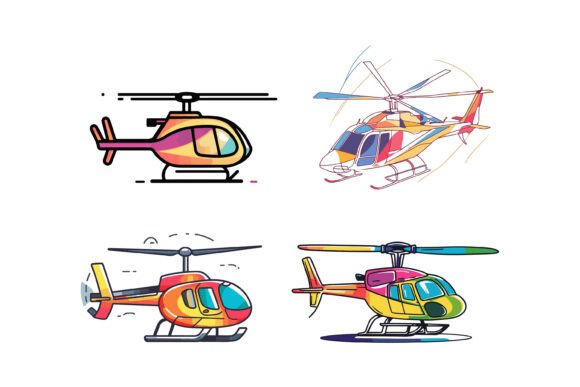
The pack we are exploring today brings together crisp linework, thoughtful composition, and utter flexibility. It arrives as an AI, EPS, and JPG bundle, which means it slots smoothly into both legacy and cutting-edge design environments. The files are built for Mac and Windows users without any platform friction. Open them in Adobe Illustrator, Affinity Designer, CorelDRAW, or even import the high-resolution JPGs into presentation software—the helicopter artwork remains sharp and usable. You are not locked into a single ecosystem, and that kind of practical thinking appeals to freelancers who switch between client machines, agencies juggling multiple OS deployments, and solo business owners who just need things to work on the first try.
What Makes a Helicopter AI EPS Pack Stand Out
Not all vector bundles are equal. Anyone who has downloaded a free icon set knows the frustration of poor layer names, unnecessary clipping masks, and line weights that crumble when scaled. The value here lies in the invisible structure—the kind of meticulous file preparation that separates a professional toolkit from a quick weekend sketch. Every helicopter icon, silhouette, and detailed side-profile has been grouped logically. Layers carry descriptive labels, making them easy to locate when you are under a tight deadline. You will not waste ten minutes hunting for the tail rotor or trying to isolate the cockpit glass. This organized layer structure directly translates into less friction and more time for fine-tuning.
Perfection in details and consistency across the set means that all illustrations maintain the same visual weight, stroke uniformity, and design language. If you pull a helicopter from the rescue category and another from the commercial aviation folder, they will sit together on a webpage or brochure without clashing. This consistency is a quiet superpower because it supports brand cohesion. A logistics company, for instance, can use the helicopter symbol across an explainer video, a PDF report, and a mobile app without the imagery looking like it came from three different designers. That uniformity builds trust with an audience, even if they never consciously notice it.
File Formats That Adapt to Your Workflow
The inclusion of AI and EPS files means you are working with true vectors. Resize a helicopter to billboard dimensions or shrink it to a favicon; the edges stay crisp. The JPG companion files serve as quick references or ready-to-use raster versions for social media posts, email headers, or placeholder graphics in wireframes. Having all three formats in one package eliminates the need to export multiple versions repeatedly. You can pull the EPS into an older publishing tool, open the AI file in Illustrator for advanced editing, and drag the JPG straight into a blog post. This trinity of formats is a quiet productivity booster that experienced designers immediately appreciate.
Another strength is editability. Each helicopter is built with separate parts—body, skids, main rotor, tail rotor, windows—so you can change colors, simplify details, or combine elements with other icons without starting from scratch. Need a fleet of helicopters in your corporate palette? Apply a global color change in a few clicks. Want to turn a standard transport chopper into an air ambulance by swapping a red cross onto the side? That is equally effortless. The flexibility extends beyond color; you can modify anchor points, adjust stroke weights, or remove components entirely. For app developers, this means creating a consistent icon family that matches streamlined UI guidelines.
Where Practical Helicopter Graphics Deliver Immediate Value
Let’s move beyond the file specs and explore actual use cases. A helicopter vector set is more versatile than many people assume at first glance. It fits across personal, professional, educational, and commercial contexts without losing relevance. Understanding a few realistic scenarios helps you gauge whether this kind of resource belongs in your permanent design library.
- Print and editorial design: Magazines covering aviation history, travel brochures highlighting scenic helicopter tours, event flyers for air rescue fundraisers, and annual reports for medical evacuation services all benefit from high-quality helicopter artwork. The vector origin ensures that CMYK or spot color conversions stay true.
- Web and digital interfaces: Dashboards monitoring fleet operations, travel booking platforms, interactive maps showing helipad locations, and notification icons for emergency alerts gain clarity with recognizable helicopter icons. Because the assets are resolution-independent, they hold up on retina screens and responsive layouts.
- Infographics and data visualization: When you need to illustrate statistics about rapid response times, cargo transport volume, or tourism numbers, a clean helicopter silhouette turns dry figures into compelling stories. The scalable vectors won’t pixelate when the infographic is enlarged for a presentation slide or printed as a poster.
- Educational materials: Teachers creating lessons on transportation, physics of rotor flight, or emergency services can use the illustrations in worksheets, slide decks, and interactive quizzes. The ability to recolor and customize means students can engage with visuals that match the exact learning context.
- App symbols and wayfinding systems: From airport signage to fitness apps tracking altitude gain (using a helicopter to symbolize rapid ascent), these icons communicate instantly. Their simplicity and recognizability reduce cognitive load for users navigating unfamiliar interfaces.
- Branding and marketing collateral: A helicopter tour company can unify its logo, social banners, vehicle decals, and merchandise with consistent vector art. When every touchpoint features the same polished helicopter symbol, brand recall strengthens without a massive design budget.
Customization That Respects Creative Freedom
One of the most frequent complaints about stock graphics is the lack of personalization. But here, the whole philosophy is built around putting you in control. You receive the original AI and EPS files, not flattened, single-layer PDFs. That means every helicopter node is accessible. You can push the design further: add a spotlight beam for a search-and-rescue scene, exaggerate the rotor blur for a sense of motion, or integrate the helicopter into a larger composite illustration. The learning curve is minimal because the layer structure is logical. Even if you are relatively new to vector editing, you can follow the groups and make meaningful changes within minutes.
Changing colors according to your needs is especially valuable when you serve multiple clients. A marketing consultant might need a blue transport helicopter today and a green environmental agency variant tomorrow. Instead of purchasing multiple packs or commissioning new art, you simply recolor the existing master artwork. This reusability stretches design budgets and accelerates delivery. Consider also seasonal campaigns: a dark silhouette for a moody autumn promotion or a bright, high-contrast version for a summer travel sale. The original files invite this kind of creative reinterpretation without degrading the source material.
Enhancing Efficiency, Communication, and Visual Impact
The practical benefits ripple through every stage of a project. Efficiency comes from instant access to a ready-made, organized system. Instead of sketching helicopter forms from memory or scouring disparate free sources for passable imagery, you start with a reliable base that reflects professional standards. This reduces turnaround time on client work and frees mental bandwidth for solving more complex design problems. When you can drag a helicopter into a wireframe and know it won’t blur on export, your prototyping speeds up.
Communication improves because a universally understood symbol crosses language barriers. A helicopter icon on a safety instruction card, an evacuation route map, or a multi-language kiosk does not need translation. It conveys urgency, transportation, or airborne access instantly. The high level of detail in these particular illustrations—down to the cockpit windows and landing gear—adds just enough realism to be informative without overwhelming the viewer. That balance is essential for signage and instructional design where ambiguity is dangerous.
Branding and user engagement similarly benefit. A application that uses consistent, appealing icons feels more polished and trustworthy. When a user sees a helicopter icon in your service that matches the quality of the rest of the interface, they perceive a cohesive product. This subtle psychological effect can influence purchase decisions, subscription renewals, and overall satisfaction. For content creators and bloggers, the same helicopter graphic can tie together a series of articles on aviation technology, making the blog appear thoughtfully curated.
Selecting and Using Your Helicopter Illustrations Wisely
Before you commit to any vector pack, consider your primary output medium. If your work is almost entirely print, verify that the color profiles and line weights suit offset or digital printing. Fortunately, these files are built with print in mind, but it never hurts to open the EPS version and check that spot colors separate as expected. For strictly digital use, the AI files will serve you best because they integrate seamlessly with screen design tools. Also, think about the range of scenarios: does the pack cover the specific helicopter types you need—such as news choppers, military airframes, private helicopters, or rescue models? The variety within a well-curated set minimizes the chance of repetition and keeps your designs fresh.
When implementing, always work from copies of the original files. Preserve the master AI and EPS documents in a safe location so you can return to the unaltered source for future projects. Create a naming convention for your customized versions that includes the client name or project code, making retrieval simple months later. If you are collaborating with a team, store the master vector files in a shared cloud folder with clear README notes about the layer structure. This small step prevents a colleague from accidentally flattening the artwork and losing editability. For app development, export the customized helicopter icons as SVGs or PNGs at the exact needed sizes and use a consistent naming pattern that matches your asset pipeline.
From a long-term perspective, investing in a well-organized vector collection pays dividends as design trends shift. A finely drawn helicopter illustration rarely goes out of style because its form is rooted in function. Unlike overly stylized icons that look dated after a season, a clean, realistic helicopter silhouette remains relevant. It adapts to minimalist layouts, maximalist collages, and everything in between. By choosing a pack that prioritizes editability and structural clarity, you secure a versatile creative resource that grows with your skills and business needs.
Whether you are rolling out a new brand identity for a charter flight service, updating an emergency response training manual, or simply adding eye-catching visuals to a presentation, the right helicopter graphic cuts through noise. It delivers a message of motion, authority, and accessibility. The AI EPS collection discussed here ticks the boxes that professionals actually care about: cross-platform compatibility, intelligent file organization, refined detail, and genuine customization freedom. So take a look at your current workflow gaps, envision where a crisp helicopter icon could elevate the output, and thenget the pack that is ready to integrate today.